
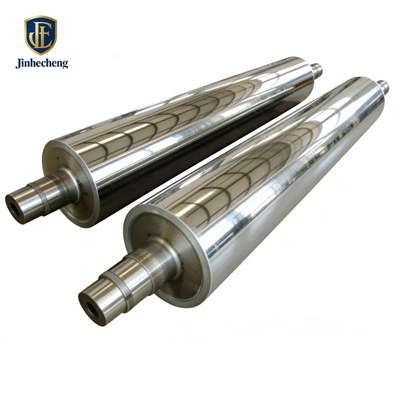
Stainless Steel Roller Hey there, fellow industry folks, it’s Jake from the rubber roller side of things. If you’ve ever scrolled through a parts catalog late at night, hunting for a rubber roller that actually works for food production—whether that’s packaging, bakery lines, or even beer bottling—you know the game is way different than regular industrial rollers. I’ve been supplying these things for 8 years now, and let me tell you: food-grade rubber rollers aren’t just “rubber that touches food.” There’s a whole checklist I live by, and if you skip even one box, you’re risking more than a downtime headache. Let’s break this down, no stuffy textbook jargon, just real talk from someone who’s had to fix a roller that made a bakery recall a whole batch of croissants (yep, that happened). First off, let’s get the biggest non-negotiable out of the way: material safety. People always ask me, “Can’t you just add a ‘food-safe’ sticker to any roller rubber?” Nope, not even close. The rubber we use here isn’t the same stuff we’d use for a warehouse conveyor that deals with chemicals or grease. It has to be made from polymers that don’t leach. Like, ever notice how some cheap rubber smells weird when it’s new? That’s volatile organic compounds (VOCs) and plasticizers that can seep into food—even if it’s just moisture or fat. For food-grade, we only use materials like silicone, EPDM, or food-grade nitrile. Why those? Silicone’s great for high temps—think ovens or pasteurizers—because it doesn’t break down when it’s hot, no off-gassing even at 400°F. EPDM is tough for things that need UV resistance, like outdoor fruit processing lines. Nitrile’s go-to if you’re dealing with oily foods, like fried chicken processing or chocolate coatings. But here’s the catch: it can’t be “technical grade” nitrile. It has to meet specific standards—FDA 21 CFR, EU 10/2011, those are the main two. A lot of suppliers will say they meet them, but when I test samples in our in-house lab, some don’t pass the migration test. Like, if you soak a piece of the roller rubber in water or a food simulant (like 95% ethanol for fatty foods) for 10 days, it can’t transfer more than a tiny amount of chemicals. I’ve turned away three orders this year alone because the rubber supplier’s paperwork was fake on that. Next up: no weird contaminants. Food plants are dirty places, let’s be real. Dust, metal shavings, even leftover mold from old equipment—if that gets into the rubber during manufacturing, it’s a ticking time bomb. So, we have super strict production protocols here. Our mixing room is a cleanroom, not the same as our regular rubber mixing bay for industrial rollers. We wear hairnets, booties, no jewelry that could fall in. All raw materials are tested for trace metals—lead, cadmium, whatever—before we even open the bucket. And when we cure the rubber? No open-air curing. We use closed, controlled presses so nothing from the ambient air (like dust or industrial fumes) sticks to it. I had a customer a few years back who bought a cheap roller from a guy down the road, and it had a metal shaving embedded in it. It scratched a packaging line, and they had to toss 12,000 protein bars. That’s not a repair bill— that’s a reputation hit. Contamination isn’t just a food safety thing; it’s a production killer. Then there’s surface quality. Food-grade rollers can’t have tiny bubbles, pits, or scratches. Why? Because those spots are perfect for bacteria to hide. Even if you sanitize the line with bleach or quaternary ammonium compounds, bacteria can get stuck in a 0.1mm pit and multiply like crazy. We run every roller through a surface finish test—our digital calipers check for imperfections down to 0.05mm. The ideal surface roughness is under 0.8 Ra, which means it’s smooth enough that food doesn’t get trapped, and sanitizer can actually reach every part of it. Another thing: no mold release agents that aren’t food-safe. When you make rubber rollers, you need mold release to get them out of the press without sticking. But some old-school mold releases are petroleum-based, which can leach into food. We use a water-based, food-grade mold release, and we even run a wipe test on every finished roller to make sure there’s zero residue left from it. Oh, and for rollers that come into direct contact with food—like dough sheeters or bottle conveyors—we don’t use any adhesives that aren’t food-grade either. Bonding the rubber to the metal core is another weak point. If the adhesive fails, the rubber peels away, and you have gaps where bacteria can grow, plus small rubber bits can break off into the food. We use a two-part epoxy that’s FDA-approved for food contact, and we cure the bonded rollers at 180°F for 24 hours, not just a quick bake. We pull test samples every week to make sure the bond is strong enough to hold up even after months of heavy use. Now, what about durability? A lot of people think “food-grade” means soft, or not tough. No, it just means it’s tough without the bad stuff. A roller for a candy line needs to grip the chocolate without scratching it, last for thousands of cycles, and still pass safety tests. We test our rollers in real-world conditions: our bakery test line runs 12 hours a day, 5 days a week, and we check the surface weekly for wear. If a roller starts to wear too fast, it’s not just a quality issue—it’s a food safety issue too. Worn rubber can create particles that get into food, same as contaminants. And don’t forget about compatibility with sanitizers. Food plants clean their lines like crazy, using everything from hot water to hydrogen peroxide to steam. The rubber has to hold up to that. If it starts to degrade from repeated cleaning, it’s going to leach chemicals sooner or later, or get too soft and lose shape. We test every material we use against common sanitizers at 140°F, which is the temp most plants use for sanitizing. If it cracks, swells, or changes color, we dump that material immediately. Last year, we tested a batch of EPDM for a juice plant—when we soaked it in 10% hydrogen peroxide for 7 days, it swelled 12%. We sent it back to the supplier, no questions asked. Now, let’s talk about something that’s easy to forget: documentation. If you’re a food plant, the FDA or EU auditors are going to ask for proof that your rollers are food-grade. Just saying “my supplier said so” isn’t enough. We give every customer a COA (Certificate of Analysis) for each roller, plus a material safety data sheet that shows it meets FDA 21 CFR Part 177, EU 10/2011, and whatever other standards their specific region or line requires. We even have traceability—if we need to, we can go back to the exact batch of rubber used, the exact production shift, every single part. Auditors love that, because it means you can prove you’re not cutting corners. I’ve had customers tell me they got audited a week after they installed our rollers, and the auditor asked for the docs, and they had them ready in 10 minutes. That’s the kind of peace of mind we give. Look, I get it—parts costs matter. I’m not going to lie to you: food-grade rollers aren’t cheap. But when you compare the cost of a recall, a line shut down, or an auditor knocking on your door? Cheap rollers end up costing way more. I’ve seen a small bakery lose $50k in a week because a roller from a cheap supplier left metal shavings in their product. That’s a small business gone, just because someone tried to save a few bucks on parts. At the end of the day, my job isn’t just to sell you a rubber roller. It’s to make sure that roller doesn’t become a problem for you, or for the people who eat the food your line makes. If you’re out there looking for rollers—whether it’s for a new bottling line, a bakery sheeter, or a fruit processing conveyor—hit me up to chat. I can send you samples, walk you through our testing process, or answer any dumb questions (I’ve heard all of them, trust me). Just reach out, no pressure, no sales pitch that’s all fluff. We can talk about what your line needs, and make sure we get you the right roller, the first time. References: U.S. Food and Drug Administration. (2023). 21 CFR Part 177: Indirect Food Additives: Polymers. European Commission. (2011). Regulation (EU) No 10/2011 on plastic materials and articles intended to come into contact with food. National Sanitation Foundation. (2022). NSF/ANSI 51: Food Equipment Materials. Rubber Roller
Qingdao Jinhecheng Machinery Co., Ltd.
Qingdao Jinhecheng Machinery Co., Ltd. is one of the most professional rubber roller manufacturers and suppliers in China, featured by quality products and low price. Please rest assured to buy discount rubber roller made in China here from our factory. Customized orders are welcome.
Address: Aishan Industrial Park, Yanghe Town, Jiaozhou, Qingdao City, Shandong Province
E-mail: alice@jhcroller.com
WebSite: https://www.jhcroller.com/
