As a supplier of X-folding container houses, I get this question at least once a week from builders, property managers, and even small business owners looking for a temporary or long-term space solution. It’s a fair one, too—airtightness isn’t just about comfort; it ties directly to energy efficiency, indoor air quality, and even structural performance, especially when it comes to modular structures that rely on precision engineering to function. Today, I want to break down what airtightness means for our X-folding container houses, how we test it, and why it matters for anyone considering these versatile structures. X-folding Container House
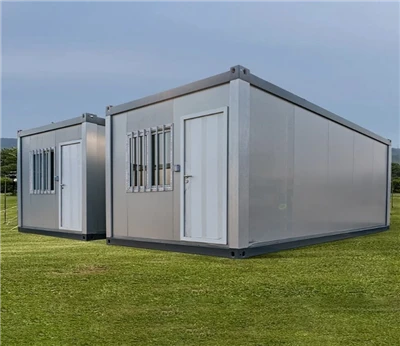
First, let’s get clear on what airtightness actually is in this context. For most people, the term is tied to homes and buildings, referring to how much air leaks through gaps, cracks, or unintentional openings in the building envelope—the parts that separate the indoor space from the outside: walls, roof, floors, windows, and doors. For a standard shipping container that’s been modified into a foldable house, early designs often had gaps where the original container’s panels joined, or where windows and doors were cut and installed. But X-folding container houses are different: they’re engineered to fold flat for transport, then expand into a full living or working space on site, which means every joint, seam, and seal is designed to hold air tightly when deployed.
Let’s start with the design choices that make our X-folding container houses airtight. Unlike traditional fixed containers, which rely on heavy-duty welds for structural integrity, our foldable models use precision-engineered interlocking frames. When the unit is unfolded, the main body panels (both the outer skin and inner wall layers) lock into place with rubber gaskets that run the length of every seam. These gaskets are made from EPDM rubber, a material widely used in construction for its resistance to weather, temperature fluctuations, and UV damage—so they don’t shrink, crack, or lose their seal over time, even in extreme climates.
We also address openings intentionally: every window and door is installed with a multi-layered seal that wraps around the frame, not just the edge. That means when the window or door is closed, there’s no gap between the frame and the wall panel. For the foldable roof, which telescopes out from the main body, we added a secondary seal along the telescoping edges to prevent air from seeping in there—a common weak point in other foldable modular structures. Another key detail is the interior wall and ceiling lining: we use spray foam insulation that adheres directly to the inner surfaces, sealing small gaps around pipes, electrical conduits, and light fixtures that would otherwise let air leak through.
Now, you might be wondering how we measure airtightness to make sure these seals work. The gold standard for measuring building airtightness is the blower door test, and we run this on every X-folding container house before it leaves our facility. Here’s how that works: a temporary fan is installed in one of the exterior openings (usually a door), and it pulls air out of the unit, creating a negative pressure inside. We then measure how much air the fan needs to move to maintain that pressure, which tells us how much air is leaking out (or in, since the test is reversible). The result is expressed as air changes per hour at 50 Pascals (ACH50)—a common industry metric for airtightness.
For context, a standard code-compliant stick-built home in the U.S. typically has an ACH50 of around 1 to 3, meaning 1 to 3 volumes of air inside the home leak out every hour at that pressure. Older, poorly sealed homes can have ACH50 of 5 or higher. Our X-folding container houses consistently test at an ACH50 of 0.8 to 1.2. That’s not just code; that’s the kind of airtightness you’d see in a high-performance energy-efficient home, with the added benefit of being foldable and transportable.
I should note that airtightness isn’t just a number for bragging rights. For someone using an X-folding container house as a permanent residence, the low ACH50 means you’ll spend less on heating and cooling. There are no random drafts around windows or doors, so your HVAC system doesn’t have to work overtime to maintain a consistent temperature. For commercial users—like pop-up retail spaces, construction site offices, or temporary event spaces—airtightness means the space stays comfortable for staff or customers, even in very hot or cold weather. It also helps with indoor air quality: less outside air leaking in means fewer dust, pollen, and pollution particles getting inside, and we can control ventilation more easily because we’re not fighting constant air leakage.
Of course, there are factors that can affect airtightness after delivery, and we always make sure our clients know about them. Proper installation is key, even with our pre-sealed units. If the unit is placed on a foundation or a skid, the gap between the bottom of the container and the ground needs to be sealed—either with a continuous foam seal along the base, or with a skirt that covers the gap, to prevent air from leaking through the floor. We also provide a detailed maintenance guide that covers checking the gaskets on the foldable joints every six months, especially if the unit is in a coastal or dusty environment, where debris could build up and affect the seal.
I’ve had clients ask me if airtightness is a problem for foldable units, since they’re moved from site to site. The short answer is no—our gaskets and interlocking frames are designed to withstand multiple folds and transports without losing their seal. We test each unit after it’s been folded and unfolded three times to simulate transport and site setup, and the ACH50 result stays within that 0.8 to 1.2 range. That’s a big difference from custom modified shipping containers, which can lose airtightness after a single move if the seams are compromised.
Another point worth mentioning: airtightness doesn’t mean the space is “sealed up” with no fresh air. That’s a common misconception. Our X-folding container houses are designed with mechanical ventilation systems that work in tandem with the airtight envelope. For residential units, we install heat recovery ventilation (HRV) systems that exchange stale indoor air with fresh outdoor air while retaining most of the heat, so you get good indoor air quality without wasting energy. For commercial units, we offer energy recovery ventilation (ERV) systems that adjust for humidity too, which is great for regions with high heat and moisture.
Let me share a real example to put this in perspective. Last year, we sold a dozen X-folding container houses to a construction company working on a remote road project in northern Canada. The average winter temperature there is -20°C (-4°F), and it gets as low as -40°C (-40°F). The company’s previous temporary offices were modified shipping containers, and they reported that the drafty units had heating costs that ran about $1,500 per month per unit. The new X-folding units we provided tested at ACH50 0.9, and their heating costs dropped to around $600 per month per unit. That’s not just a small savings—that’s a huge difference for a project with 12 units, adding up to $10,800 per month. The company also said the workers were more comfortable, because there were no cold drafts blowing through the office during work hours.
Another client was a retail brand that needed temporary pop-up shops in urban areas with high foot traffic. They were worried that wind or rain would get in through gaps, but our airtight design meant the shops stayed dry even during heavy rainstorms, and the climate control kept the space comfortable for customers, even in the middle of summer. They’ve since ordered 15 more units for future pop-ups, specifically citing the airtightness as a key reason.
I want to be clear: no structure is perfectly airtight, and some air exchange is necessary for indoor air quality. But our X-folding container houses strike that balance. We don’t seal out all air, just the unintended leaks that waste energy and reduce comfort. That’s why the ACH50 metric is so important—it measures exactly those unintentional leaks, not the intentional ventilation we build into the unit.
If you’re considering an X-folding container house, airtightness should be a top priority to evaluate, right alongside transport size, interior layout, and local building codes. A unit with a high ACH50 (over 2) might cost less upfront, but it will cost you more in energy bills over time, and it won’t be as comfortable to use. All our units come with the blower door test results on hand, and we’re happy to walk you through the numbers to show you how it translates to real-world performance.
At the end of the day, airtightness is about making a modular space that works as hard for you as you work for it. Whether you’re using it for a home, an office, a retail space, or a temporary project, it should keep you comfortable, save you money, and last for years. Our X-folding container houses are engineered with that in mind, and the airtightness is a core part of that design.

If you’re ready to learn more about how our X-folding container houses can fit your needs, or you want to get specific details on airtightness for a particular climate or use case, reach out to our team to connect for a procurement discussion. We’re here to answer questions, share test data, and help you find the right solution.
Apple Cabin References:
- American Society of Heating, Refrigerating and Air-Conditioning Engineers. ASHRAE Handbook of Fundamentals. 2021.
- International Code Council. International Energy Conservation Code (IECC). 2021.
- Container Residential Association. Modular Structure Airtightness Guidelines. 2022.
- EPDM Rubber Association. Properties of EPDM Seals for Construction Applications. 2020.
Tangshan Jingrong Trading Co., Limited
With abundant experience, we are one of the most professional x-folding container house manufacturers and suppliers in China. Please feel free to wholesale customized x-folding container house made in China here from our factory. For price consultation, contact us.
Address: Room 1103, Tangshan Rongtong Building, Lubei District, Tangshan City, Hebei Province.
E-mail: Linda@tscontainerhouse.com
WebSite: https://www.tscontainerhouse.com/
